
Bitcoin’s Speed Issue
Bitcoin is the first cryptocurrency and the long-reigning largest cryptocurrency by market cap. But it has a speed issue. The Bitcoin network can process up to 7 transactions per second that take about 10 minutes to execute. By contrast, VISA processes about 1,600 transactions every second.
The slow transaction speeds was a real speed bump on the large-scale adoption of Bitcoin. Options for reducing processing time included modifying the protocol to reduce the amount of information included in each block or increasing the size of the blocks (in order to process more information).
In 2017, disagreements between Bitcoin’s stakeholders (developers, miners and coin-holders) reached a head. Bitcoin decided to incorporate SegWit2x technology which reduces the data to be validated in each block by deleting the signature data from the data block to be processed per transaction.
Bitcoin Cash (BCH)
A group of miners and developers who were concerned about improving the speed of the Bitcoin network but feared a lack of transparency regarding the introduction of SegWit2x decided to launch a hard fork to create Bitcoin Cash in August 2017. Bitcoin Cash implemented an increased block size of 8 MB to accelerate the verification process.
A “hard fork” is a duplication of a blockchain to create a new blockchain on which a new cryptocurrency evolves. Anyone holding the original coin at the time it was forked will automatically get the forked version of the coin they were holding. So, when Bitcoin forked to Bitcoin Cash, someone who had 10 BTC would automatically have received a certain number of BCH matching the value of their 10 BTC.
Bitcoin Satoshi Vision (BSV )
Even after the fork, the Bitcoin Cash community continued to clash over the future of the cryptocurrency. In 2018, the community fractured even further, breaking off into Bitcoin ABC (Adjustable Block size Cap) and Bitcoin SV (Satoshi Vision).
A group led by Craig Wright (who claims to be the real Satoshi Nakamoto) and Calvin Ayre of CoinGeek proposed to restore “the original Satoshi protocol” by changing the BCH structure to increase the block size of BCH from 32 MB to a maximum of 128 MB to elevate network capacity and scale. BSV proponents push a “miners first” philosophy, claiming that the move will lead to more long-term revenue for miners by restoring the original Bitcoin protocol.
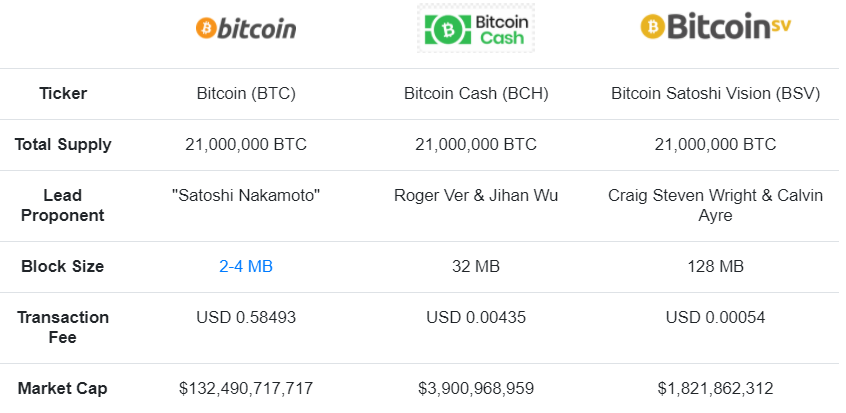
At a Glance: Bitcoin (BTC), Bitcoin Cash (BCH) & Bitcoin Satoshi Vision (BSV) Compared
Here’re the key deets TABUL8TED!
Enjoyed this post?
- LIKE👏, SHARE🤲 & SUBSCRIBE👣
- READ MORE:
- Read TABUL8TOR’s beginner’s guide to blockchain, cryptocurrencies, cryptocurrency exchanges, cryptocurrency wallets.
- Read TABUL8TOR’s posts on blockchain use cases: Kleros, CryptoKitties and Blockchain Cuties.
***Disclaimer: This post is for informational purposes only and does not constitute a recommendation to buy cryptocurrencies. Please do your own due diligence before taking any action.
 tabul8tor